
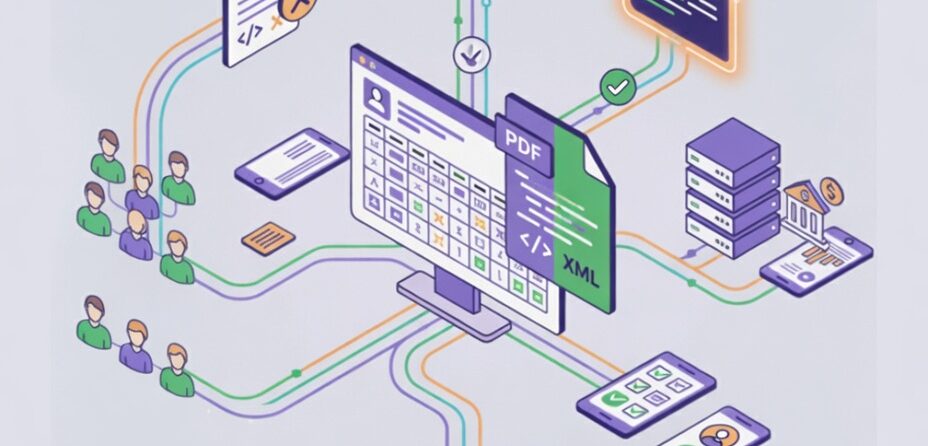
The switch to electronic invoicing is no longer optional – from 2025/2026 onwards, it will become mandatory for large parts of the B2B sector. Making that transition smooth requires one thing above all: clear, proactive communication with your suppliers.
Why good communication makes all the difference
Electronic invoices in XML format are not simply digital versions of a PDF. They contain machine-readable data fields that enable automatic processing in accounting and ERP systems – but only when they are correctly structured and complete.
Companies that don't inform their suppliers in time risk receiving faulty invoices, creating manual rework and causing avoidable delays. A well-thought-out communication strategy prevents exactly these problems.
Clearly define supported formats
XRechnung (pure XML) and ZUGFeRD/Factur-X (PDF + XML) are the common standards. A plain PDF without embedded XML data does not meet e-invoicing requirements.
Explain the billbox ID & addressing
Suppliers need to know where and how to include the billbox ID in their invoice data, so that automatic matching works without manual intervention.
Define the transmission channel
Whether via email, Peppol network or an invoice portal – the channel must be clearly communicated and technically ready before go-live.
Subject: Switching to electronic invoicing – important information for you
Dear Sir or Madam,
As of 2026, we will only accept invoices in a structured XML format (XRechnung or ZUGFeRD/Factur-X). Please include our billbox ID [xxxx] in your invoice data to ensure automatic matching.
Our technical requirements and a step-by-step guide are available at [link]. If you have any questions, please contact [name, contact details].
Kind regards, [Your company]
Subject: Your invoice dated 2026 – correction required
Dear Sir or Madam,
Thank you for your invoice. Unfortunately, the document submitted does not meet the requirements for a machine-readable XML e-invoice. Please resubmit it with the correct mandatory fields and our billbox ID [xxxx].
We are happy to assist if you have any questions: [contact].
Best regards, [Your company]
Unclear format requirements
Many suppliers are not aware of the difference between a standard PDF and an XML-based e-invoice. Without clear guidance, non-compliant documents will keep arriving in your inbox.
Missing mandatory fields
Formats like XRechnung require all mandatory fields to be filled in correctly – invoice number, routing ID, tax rate. A single missing field will cause the invoice to be rejected automatically.
No point of contact for technical questions
When suppliers don't know who to turn to, delays follow – and invoices get resubmitted multiple times with the same errors.
Checklist: Is your supplier communication complete?
- Supported e-invoice formats defined
- billbox ID and addressing rules communicated
- Transmission channel clarified
- Mandatory fields checklist created
- Communication templates prepared
- Point of contact named
- FAQ document or help page available
- Follow-up planned for ~4 weeks after rollout
Conclusion: Clear communication accelerates the entire process
The technical side of switching to e-invoicing is one part of the equation – bringing your suppliers along is the other. With precise format requirements, easy-to-use templates and a named point of contact, you set the foundation for invoices that arrive correctly from day one and are processed automatically.
The result: fewer queries, less manual effort and an invoicing workflow that simply works.
